قبل المتابعة
بالنقر على ”قبول الكل“، فإنك توافق على تخزين ملفات تعريف الارتباط على جهازك لتحسين تصفح الموقع وتحليل استخدام الموقع والمساعدة في جهودنا التسويقية.
SLT Laser for Glaucoma: Lowering Eye Pressure, Often Without Daily Drops

SLT Laser for Glaucoma: Lowering Eye Pressure, Often Without Daily Drops

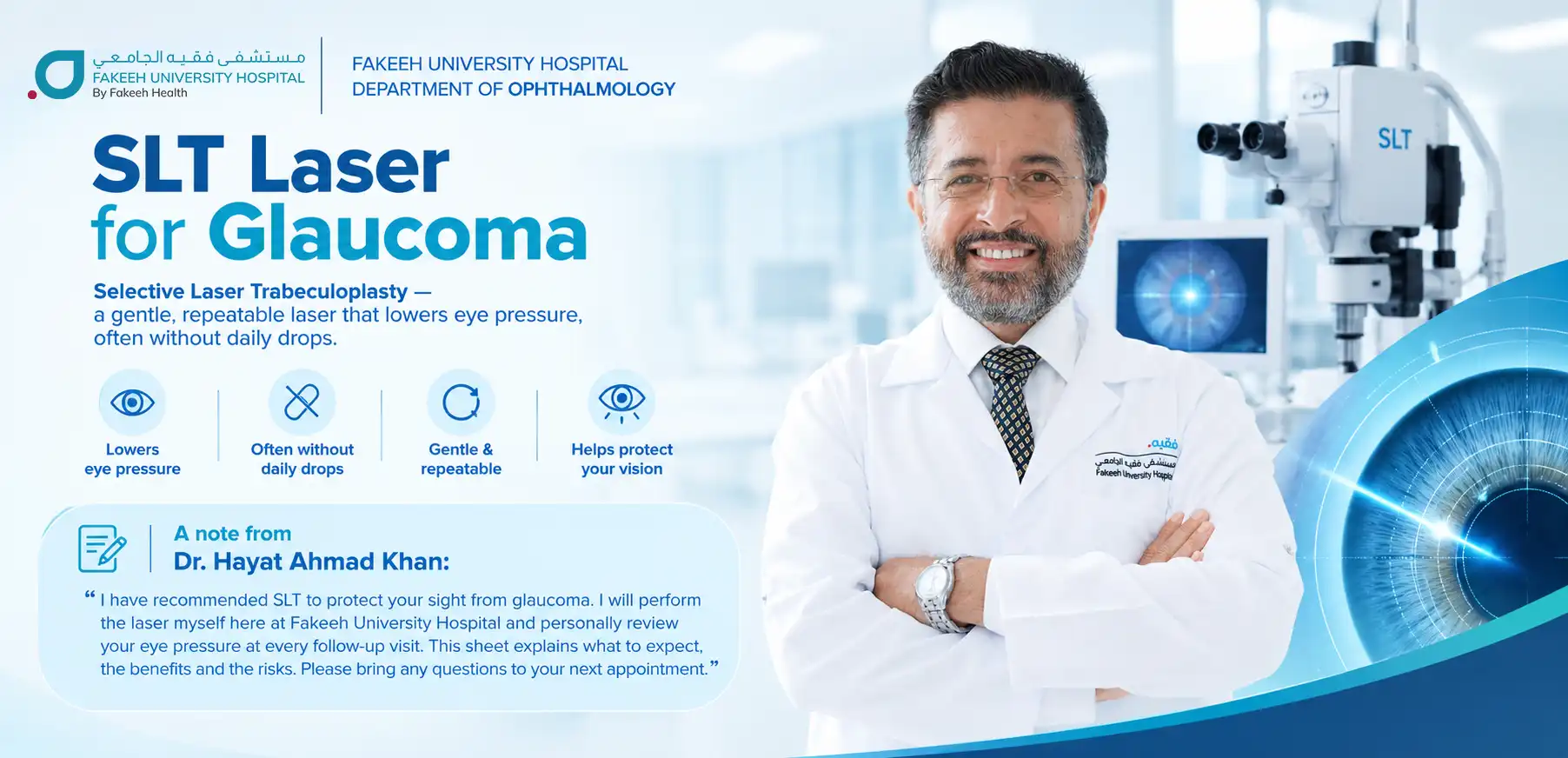
If you have been diagnosed with glaucoma, you may have been told about a treatment called SLT. Selective Laser Trabeculoplasty, or SLT, is a gentle, repeatable laser that helps lower the pressure inside the eye, often reducing or removing the need for daily eye drops.

At Fakeeh University Hospital, Department of Ophthalmology, this article explains what SLT is, how it works, and the benefits and risks, so you can feel informed and prepared. As always, your own doctor remains the best source of advice for your individual situation.

What is glaucoma?

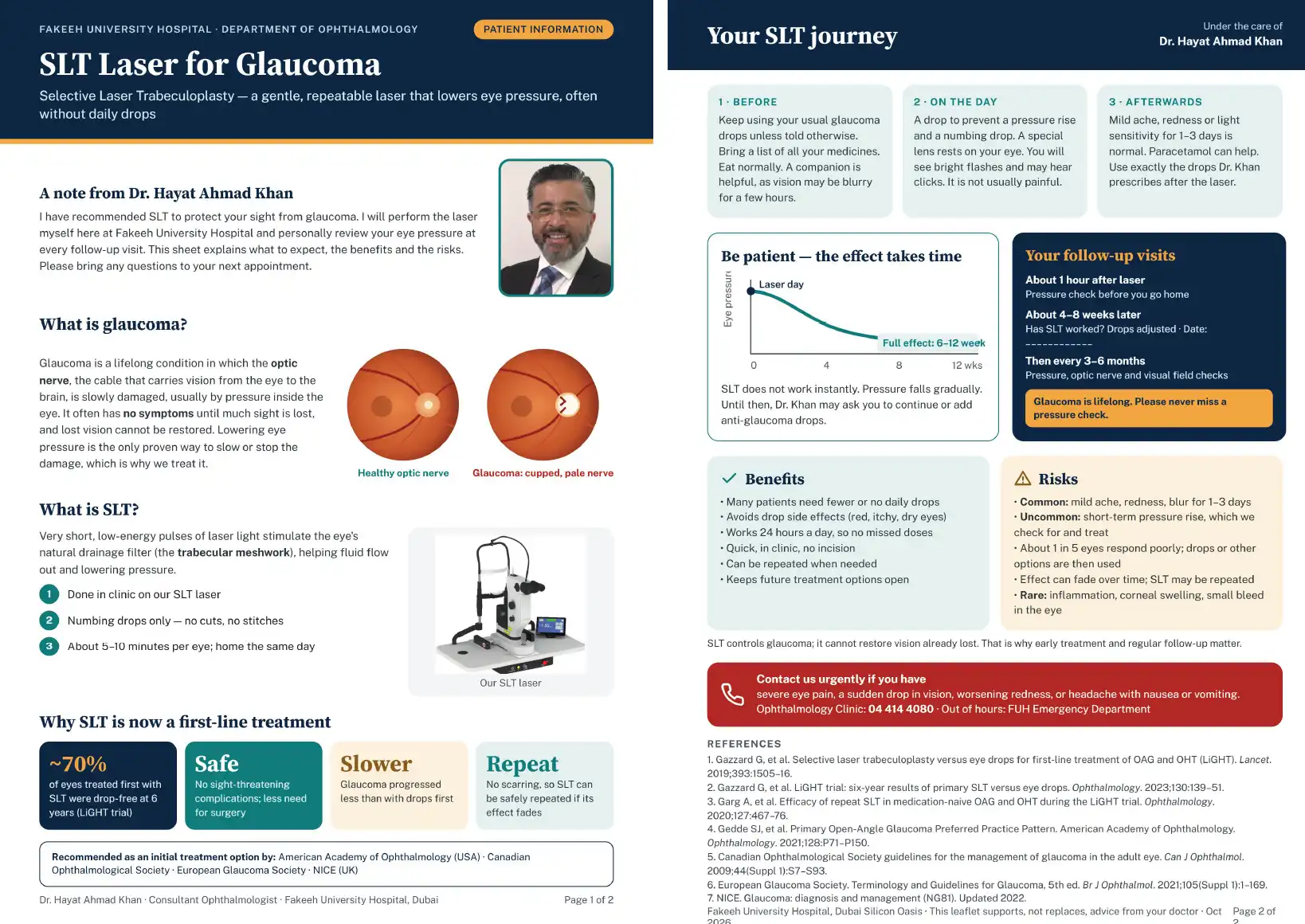
Glaucoma is a lifelong condition in which the optic nerve, the cable that carries vision from the eye to the brain, is slowly damaged. This is usually caused by raised pressure inside the eye.

Glaucoma often has no symptoms until a significant amount of sight has been lost, and once vision is lost, it cannot be restored. Lowering the pressure inside the eye is currently the only proven way to slow or stop the damage, which is why treating it matters so much.

What is SLT?

SLT uses very short, low-energy pulses of laser light to gently stimulate the eye's natural drainage filter, known as the trabecular meshwork. This helps fluid flow out of the eye more easily, which in turn lowers the pressure inside it.

Here is what the procedure involves:
  • It is done in clinic, using the SLT laser
  • Only numbing drops are needed, with no cuts and no stitches
  • It takes around 5 to 10 minutes per eye, and you can go home the same day
Dr. Hayat Ahmad Khan - Section Head of Ophthalmology / Consultant Ophthalmologist at Fakeeh University Hospital

Why is SLT recommended as a first-line treatment?

SLT is now recommended as an initial treatment option for glaucoma by leading professional bodies, including the American Academy of Ophthalmology, the Canadian Ophthalmological Society, the European Glaucoma Society, and NICE in the UK.

This is supported by research. In the LiGHT trial, a large clinical study of SLT:

  • Around 70% of eyes treated first with SLT remained free of drops at six years
  • SLT was not associated with sight-threatening complications, and patients were less likely to need surgery
  • Glaucoma progressed less often than in those who started with drops

Because SLT does not cause scarring, it can also be safely repeated if its effect fades over time.

What are the benefits of SLT?

For many patients, SLT offers a number of advantages:

  • Many patients need fewer or no daily eye drops
  • It avoids the side effects that drops can cause, such as red, itchy, or dry eyes
  • It works around the clock, so there are no doses to remember or miss
  • It is quick, done in clinic, and involves no incision
  • It can be repeated when needed
  • It keeps your future treatment options open

What are the risks of SLT?

Like any procedure, SLT carries some risks, and it is important to understand them:

  • Common: mild ache, redness, or blurred vision for 1 to 3 days
  • Uncommon: a short-term rise in eye pressure, which your doctor checks for and treats
  • Around 1 in 5 eyes respond poorly to SLT, in which case drops or other options are then used
  • The effect can fade over time, and SLT may need to be repeated
  • Rare: inflammation, corneal swelling, or a small bleed in the eye

It is also important to remember that SLT controls glaucoma, but it cannot restore vision that has already been lost. This is exactly why early treatment and regular follow-up are so important.

What to expect: before, during, and after

Before the procedure: Keep using your usual glaucoma drops unless you are told otherwise, and bring a list of all your medicines. You can eat normally. It helps to bring a companion, as your vision may be blurry for a few hours afterwards.

On the day: You will be given a drop to help prevent a pressure rise, along with a numbing drop. A special lens rests gently on your eye. You will see bright flashes and may hear clicking sounds. The procedure is not usually painful.

Afterwards: Mild ache, redness, or light sensitivity for 1 to 3 days is normal, and simple pain relief such as paracetamol can help. It is important to use exactly the drops your doctor prescribes after the laser.

Why the effect takes time, and why follow-up matters

SLT does not work instantly. The pressure in the eye falls gradually, with the full effect usually seen around 6 to 12 weeks after treatment. During this time, your doctor may ask you to continue or add anti-glaucoma drops.

Your follow-up visits are an essential part of your care:

  • About 1 hour after the laser, your pressure is checked before you go home
  • About 4 to 8 weeks later, your doctor reviews whether SLT has worked and adjusts your drops if needed
  • Then, every 3 to 6 months, your pressure, optic nerve, and visual field are checked

Because glaucoma is a lifelong condition, it is important never to miss a pressure check, even if your eyes feel completely fine.

When to seek urgent care

Contact your ophthalmology team urgently if you experience severe eye pain, a sudden drop in vision, worsening redness, or a headache with nausea or vomiting.

Glaucoma Care at Fakeeh University Hospital

Protecting your sight starts with understanding your condition and the options available to you. At Fakeeh University Hospital, Dr. Hayat Ahmad Khan, Consultant Ophthalmologist, and our ophthalmology team are here to assess your eyes, explain your options, and support you with ongoing care.

If you have questions about glaucoma or SLT, we are here to help.

This article is for general information and supports, but does not replace, the advice of your doctor.
References

  1. Gazzard G, et al. Selective laser trabeculoplasty versus eyedrops for first-line treatment of OAG and OHT (LiGHT). Lancet.2019;393:1505–16.
  2. Gazzard G, et al. LiGHT trial: six-year results of primarySLT versus eye drops. Ophthalmology. 2023;130:139–51.
  3. Garg A, et al. Efficacy of repeat SLT in medication-naiveOAG and OHT during the LiGHT trial. Ophthalmology. 2020;127:467–76.
  4. Gedde SJ, et al. Primary Open-Angle Glaucoma PreferredPractice Pattern. American Academy of Ophthalmology. Ophthalmology.2021;128:P71–P150.
  5. Canadian Ophthalmological Society guidelines for themanagement of glaucoma in the adult eye. Can J Ophthalmol. 2009;44(Suppl1):S7–S93.
  6. European Glaucoma Society. Terminology and Guidelines forGlaucoma, 5th ed. Br J Ophthalmol. 2021;105(Suppl 1):1–169.
  7. NICE. Glaucoma: diagnosis and management (NG81). Updated2022.

كتبه

Last update date: 23-10-2025
د. حياة أحمد خان
كتبه
د. حياة أحمد خان
استشاري طب العيون

تمت المراجعة بواسطة

تاريخ آخر تحديث: 23-10-2025
د. حياة أحمد خان
تمت المراجعة بواسطة
د. حياة أحمد خان

الأسئلة الشائعة

No items found.

منشورات ذات صلة

أعراض الجلوكوما وأسبابها وعلاجها في دبي

أعراض الجلوكوما وأسبابها وعلاجها في دبي

عرض التفاصيل
ما العلاقة بين مرض السكري وإعتام عدسة العين (الكتاركت)؟

ما العلاقة بين مرض السكري وإعتام عدسة العين (الكتاركت)؟

عرض التفاصيل
نصائح للعناية المنزلية بالعين الجافة أو المتوترة

نصائح للعناية المنزلية بالعين الجافة أو المتوترة

عرض التفاصيل
ما هو إجهاد العين الرقمي؟

ما هو إجهاد العين الرقمي؟

عرض التفاصيل
اعتلال الشبكية السكري

اعتلال الشبكية السكري

عرض التفاصيل
اعتمام عدسة العين

اعتمام عدسة العين

عرض التفاصيل