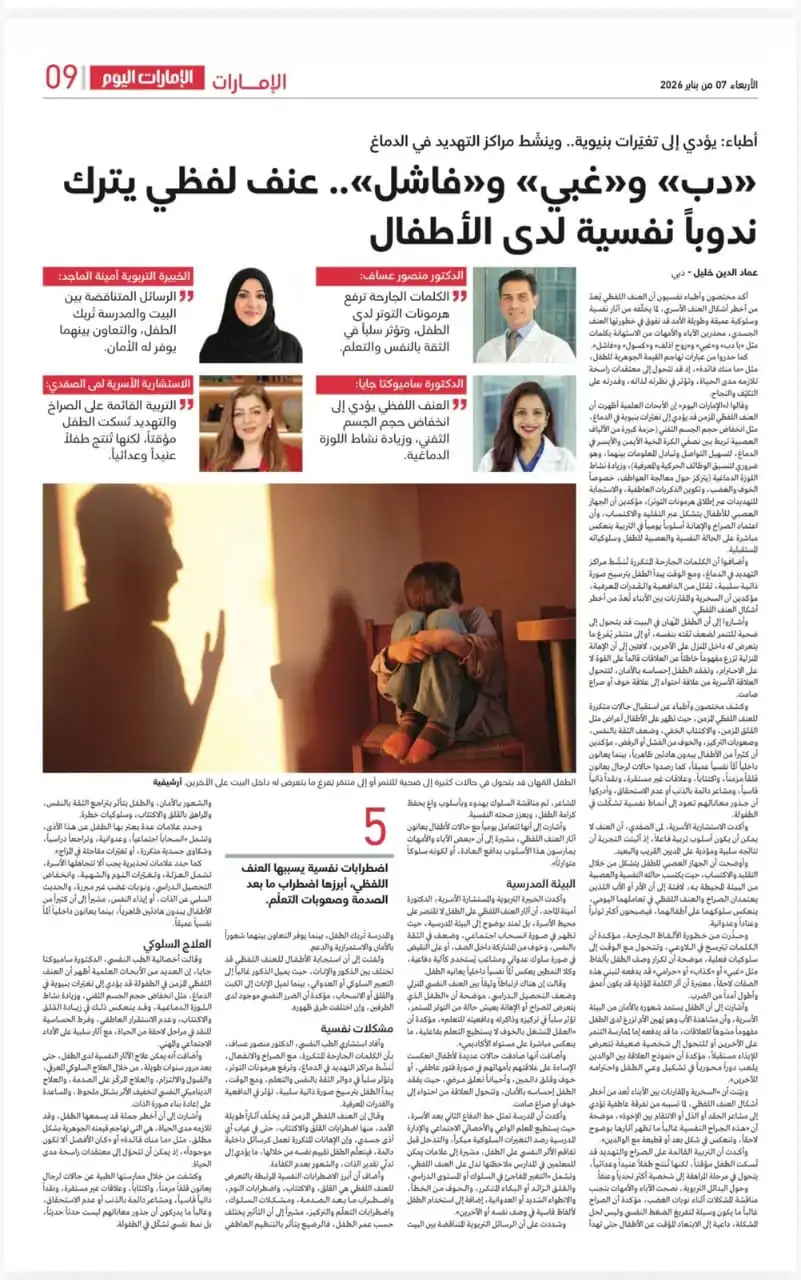
.webp)
Words matter especially when spoken to a child. Specialists and psychiatrists warn that verbal abuse is one of the most dangerous and underestimated forms of domestic violence, leaving deep psychological, emotional, and neurological scars that may last a lifetime.
Unlike physical abuse, verbal violence often leaves no visible marks, yet its long-term effects can be equally if not more damaging.
Parents may dismiss phrases like “lazy,” “stupid,” “go away,” “failure,” or “you’re useless” as moments of frustration. However, experts caution that repeated verbal humiliation attacks a child’s intrinsic sense of self, shaping how they view their worth, abilities, and place in the world.
Over time, these words can become deeply ingrained beliefs, influencing a child’s behavior, confidence, and emotional resilience well into adulthood.
Scientific research has shown that chronic verbal abuse can lead to structural changes in the developing brain, including:
Children’s nervous systems are shaped through imitation and emotional learning. When shouting, insults, and humiliation become daily parenting tools, the child’s brain adapts to a constant state of threat.
Over time, this can impair:
A mind that is constantly in survival mode cannot learn or thrive effectively.
Specialists report that children exposed to chronic verbal abuse often present with:
Many children appear outwardly calm, while internally suffering deep psychological pain that goes unnoticed for years.
Experts explain that a child humiliated at home may:
Verbal abuse also teaches children a distorted model of relationships—power instead of respect, fear instead of safety—transforming the family environment from a source of comfort into one of silent conflict.
Psychiatrists note that many adults seeking mental health support for:
eventually discover that their struggles trace back to verbal abuse experienced in childhood.
Repeated insults become internalized messages that shape lifelong self-evaluation.
Educational experts highlight that the impact of verbal abuse extends beyond the home and into school life, appearing as:
Teachers may notice warning signs such as sudden academic decline, excessive anxiety, fear of making mistakes, frequent crying, or children using harsh language to describe themselves.
A child living in constant emotional tension cannot focus, remember, or feel motivated to learn.
.webp)
Family counselors warn that mockery and constant comparison between siblings are among the most dangerous forms of verbal violence. These behaviors create emotional division, resentment, humiliation, and long-term sibling conflict that may persist into adulthood.
Experts emphasize that violence—verbal or physical—is never an effective parenting tool. While shouting may silence a child temporarily, it often produces:
Healthier approaches include:
Children need containment, not intimidation, to feel safe and emotionally secure.
The good news: Healing is possible.
Psychiatrists confirm that the effects of verbal abuse can be significantly reduced—even years later—through evidence-based therapies such as:
These approaches help rebuild self-image, emotional regulation, and resilience.
The most dangerous sentences a child can hear are those that attack their intrinsic value, such as:
“You are useless.”
“It would have been better if you didn’t exist.”
Such statements can become lifelong beliefs.
Words shape brains.
Words shape futures.
Choosing compassion, awareness, and respectful communication is not weakness it is powerful parenting that protects a child’s mental health for life.