Every year on April 11th, the world observes World Parkinson's Day a global moment of awareness for one of the most common and most complex neurological conditions affecting people today. Parkinson's disease is a progressive neurological disorder that affects movement, coordination, and a range of other physical and cognitive functions. It is the second most common neurodegenerative disease in the world after Alzheimer's, affecting an estimated 10 million people globally and yet it remains widely misunderstood, frequently underdiagnosed in its early stages, and often not discussed openly enough in communities across the UAE and the wider Middle East.
The good news is that Parkinson's disease is one of the most actively researched conditions in neurology today. Treatment options have expanded significantly in recent years, and when diagnosed early, the right management plan can dramatically slow progression, protect quality of life, and keep people active, independent, and doing the things that matter most to them for far longer than many patients initially expect.
At Fakeeh University Hospital Dubai, our neurology team provides expert diagnosis, personalised management, and compassionate long-term care for patients living with Parkinson's disease and for the families who support them. This comprehensive guide explains everything you need to know about Parkinson's disease from what it is and what causes it, to how it is diagnosed and what modern treatment can achieve.
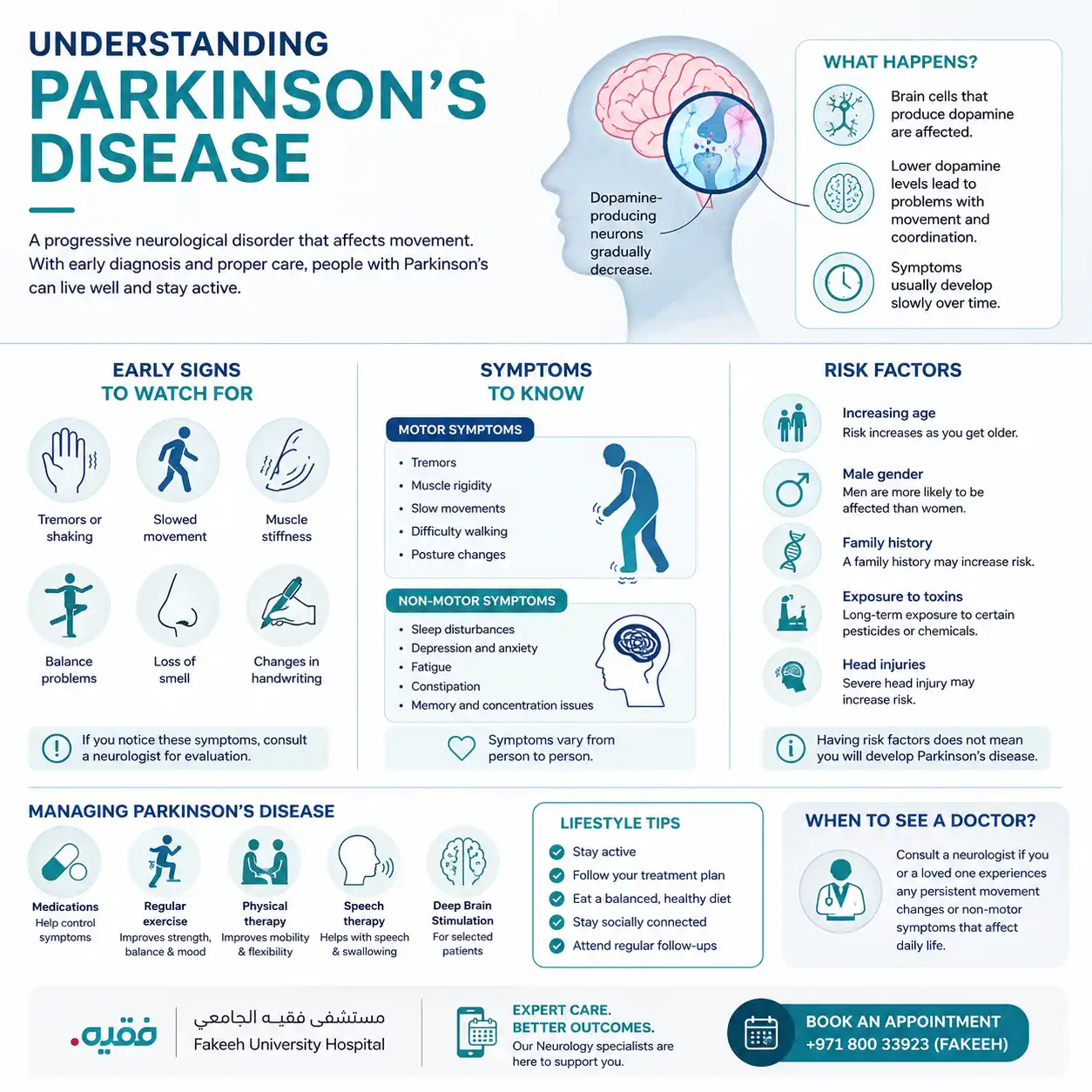
Parkinson's disease is a progressive neurodegenerative disorder meaning it is caused by the gradual degeneration of specific nerve cells in the brain, and its effects become more pronounced over time. At its core, Parkinson's is caused by the loss of neurons in a region of the brain called the substantia nigra a small but critical area located in the midbrain that is responsible for producing dopamine, a neurotransmitter that plays a central role in coordinating smooth, controlled movement.
As dopamine-producing neurons in the substantia nigra are progressively lost, the brain's ability to coordinate and regulate movement becomes increasingly impaired. The result is the characteristic movement symptoms of Parkinson's tremor, stiffness, slowness of movement, and balance difficulties.
However, Parkinson's disease is not only a movement disorder. As understanding of the condition has deepened, it has become clear that the neurodegenerative process affects far more of the brain and nervous system than the substantia nigra alone explaining why Parkinson's also causes non-motor symptoms including sleep disturbances, cognitive changes, mood disorders, autonomic dysfunction, and sensory problems.
Another hallmark of Parkinson's disease at the cellular level is the formation of Lewy bodies abnormal clumps of a protein called alpha-synuclein that accumulate within neurons. The exact role Lewy bodies play in causing neuronal death is the subject of ongoing research, but their presence is considered a defining pathological feature of the disease.
Parkinson's disease can affect anyone, but certain factors influence risk:
Age is the single strongest risk factor. Parkinson's is predominantly a disease of older adults, with the majority of cases diagnosed in people over the age of 60. However, approximately 10 to 15 percent of cases are diagnosed before the age of 50 a condition known as young-onset Parkinson's disease.
Sex plays a role men are approximately 1.5 times more likely to develop Parkinson's disease than women, though the reasons for this disparity are not fully understood.
Family history and genetics contribute to risk in a subset of patients. Approximately 10 to 15 percent of Parkinson's cases have a clear genetic component with mutations in genes including LRRK2, PINK1, PARKIN, and SNCA identified as risk factors. Having a first-degree relative with Parkinson's approximately doubles an individual's lifetime risk.
Environmental factors including long-term exposure to certain pesticides, herbicides, and heavy metals have been associated with increased Parkinson's risk in epidemiological studies though no single environmental cause has been definitively established.
Head trauma particularly repeated head injuries has been associated with increased risk of Parkinson's and related movement disorders.
The precise cause of Parkinson's disease in most patients is not fully understood and this is one of the most intensively researched questions in neuroscience. What is clear is that Parkinson's disease in the majority of patients results from a complex interaction between genetic susceptibility and environmental factors neither alone being sufficient to cause the disease in most cases.
The neurodegenerative process likely begins years or even decades before the first motor symptoms appear a period known as the prodromal phase of Parkinson's disease. During this period, the disease may manifest through subtle non-motor symptoms including loss of smell, constipation, REM sleep behaviour disorder, and mood changes none of which are typically recognised as early Parkinson's warning signs by patients or their general practitioners.
By the time the classic motor symptoms emerge, it is estimated that approximately 60 to 70 percent of dopamine-producing neurons in the substantia nigra have already been lost. This has profound implications for treatment and is one of the key reasons why the development of reliable biomarkers for early Parkinson's detection is such an important area of current research.
Parkinson's disease is characterised by a wide range of symptoms both motor and non-motor that vary considerably in type, combination, and severity between individuals. No two patients with Parkinson's have exactly the same experience of the condition.
The non-motor symptoms of Parkinson's disease are increasingly recognised as having an equally or sometimes even greater impact on quality of life than the motor symptoms.
There is no definitive blood test, brain scan, or genetic test that diagnoses Parkinson's disease with certainty in clinical practice. Diagnosis remains primarily clinical based on a thorough neurological history and examination by a specialist.
The diagnosis of Parkinson's disease requires:
While diagnosis is clinical, a range of investigations support the diagnostic process and help exclude other conditions:
One of the most common diagnostic challenges in neurology is distinguishing Parkinson's disease from essential tremor the most common movement disorder globally.
The key distinguishing features are:
A DaTscan is abnormal in Parkinson's disease and normal in essential tremor providing an objective distinction when the clinical picture is unclear.
Parkinson's disease is typically described using the Hoehn and Yahr scale a five-stage classification of disease severity:
It is important to emphasise that the rate of progression through these stages varies considerably between individuals and that with optimal treatment, many patients remain at earlier stages of the scale for many years.
There is currently no cure for Parkinson's disease but it is one of the most treatable neurodegenerative conditions, with a wide and expanding range of pharmacological, surgical, and supportive treatment options that can dramatically improve symptoms, function, and quality of life.
Deep Brain Stimulation (DBS) is the most established and effective surgical treatment for Parkinson's disease and represents one of the most significant advances in neurology in the past three decades.
DBS involves the surgical implantation of electrodes into specific brain targets most commonly the subthalamic nucleus (STN) or globus pallidus interna (GPi) connected to a pulse generator implanted under the skin of the chest. The pulse generator delivers continuous electrical stimulation to the target brain region, modulating the abnormal neural circuitry that produces Parkinson's symptoms.
DBS is most effective for patients with:
The benefits of DBS can include dramatic reduction in tremor, significant reduction in motor fluctuations, reduction in medication requirements, and improved quality of life often sustained for many years after implantation.
Focused Ultrasound is a newer non-invasive procedure that uses focused sound waves to create a precisely targeted lesion in the thalamus providing sustained tremor relief without surgical incision. It is currently approved primarily for essential tremor and tremor-dominant Parkinson's disease.
A Parkinson's diagnosis is not a sentence of rapid decline. With the right care, the right medication, and the right lifestyle modifications, the majority of patients live productive, meaningful, and active lives for many years often decades after diagnosis.
The experience of Parkinson's varies enormously between individuals. Some patients progress slowly, remain at an early stage for many years, and maintain independence well into their 70s and beyond. Others experience a faster progression that requires more intensive management and earlier involvement of multidisciplinary support.
What matters most is starting the right treatment at the right time with a specialist neurologist who understands the nuances of the condition and is committed to regular review and adjustment of the care plan as the disease evolves.
It also matters that patients with Parkinson's feel genuinely supported not just medically, but emotionally, practically, and socially. The impact of Parkinson's on caregivers and families is profound, and the best care models involve the whole family unit not just the patient.
Seek a neurological evaluation if you notice any of the following in yourself or a loved one:
Early diagnosis matters. The earlier Parkinson's disease is identified, the more treatment options are available and the more time patients and their care teams have to build the right management plan before significant disability develops.
At Fakeeh University Hospital, our neurology department provides comprehensive, multidisciplinary assessment and management for patients with Parkinson's disease and all movement disorders from initial diagnostic evaluation through long-term specialist follow-up.
Our Parkinson's care includes:



%252520(1).webp)