Spinal infections are rare but potentially serious conditions in which bacteria, fungi, or other pathogens infect the tissues of the spine. These infections may involve the vertebrae, intervertebral discs, or surrounding soft tissues, and can lead to severe complications if not treated promptly.
At Fakeeh University Hospital Dubai, our spine specialists provide comprehensive evaluation and individualized treatment for patients with spinal infections. Using advanced imaging, laboratory diagnostics, and multidisciplinary care, our goal is to eliminate the infection, protect neurological function, and preserve spinal stability.
Early diagnosis and appropriate treatment are critical to prevent long-term complications such as spinal deformity, neurological damage, or systemic infection.
Spondylodiscitis is a specific type of spinal infection that affects both the intervertebral disc and the adjacent vertebrae.
The infection usually develops when microorganisms spread through the bloodstream from another part of the body and settle in the spinal structures.
Common sources of infection may include:
Urinary tract infections
In some cases, spinal infections may occur after spinal surgery or invasive medical procedures, although this is uncommon.
Spinal infections can be caused by different types of microorganisms.
Bacterial infections are the most common cause of spinal infections. The bacteria most frequently involved include:
These bacteria may enter the bloodstream and travel to the spine, where they establish an infection.
Fungal infections of the spine are less common but may occur in individuals with weakened immune systems.
These infections often develop more slowly but can still lead to significant spinal damage if untreated.
Several medical conditions may increase the risk of developing a spinal infection, including:
Individuals with weakened immune systems are generally more susceptible to infection.
Symptoms of spinal infections can develop gradually and may initially be nonspecific.
Common symptoms include:
Many patients may also experience systemic symptoms such as:
If the infection compresses the spinal cord or nerve roots, neurological symptoms may occur, including:
Prompt medical evaluation is essential if these symptoms occur, especially in individuals with risk factors or after recent surgery.
At Fakeeh University Hospital Dubai, diagnosis involves a combination of clinical evaluation, laboratory tests, and advanced imaging studies.
The physician evaluates symptoms, spinal tenderness, neurological function, and general health status.
This helps determine whether infection may be affecting the spinal structures.
Laboratory tests can help detect signs of infection.
These tests may include:
These markers often indicate the presence of inflammation or infection.
Imaging studies are essential to identify the location and extent of infection.
These may include:
In some cases, a CT-guided biopsy may be required to obtain a sample of infected tissue. This allows precise identification of the microorganism responsible for the infection and helps guide targeted treatment.
Treatment depends on the severity of the infection, the underlying organism, and the patient’s overall health.
The main goals of treatment are to eliminate the infection, relieve pain, and prevent neurological complications.
The cornerstone of treatment is targeted antimicrobial therapy.
Most patients require intravenous antibiotics or antifungal medications, often administered for several weeks.
Treatment duration may extend to several months depending on the severity of the infection.
Pain management may include anti-inflammatory medications and supportive therapies to relieve discomfort during the healing process.
In certain cases, spinal bracing may help stabilize the spine, reduce pain, and prevent further structural damage while the infection is treated.
Surgery may be required if:
Surgical treatment aims to:
Modern surgical techniques allow effective treatment while preserving spinal function.
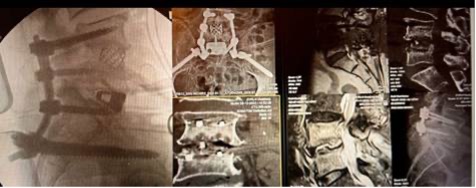
A 60-year-old patient from Germany underwent a lumbar spinal fusion procedure at another clinic. Shortly after the operation, he developed severe lower back pain, fever, and markedly elevated infection markers in laboratory tests.
Advanced imaging studies revealed a significant postoperative spinal infection in the form of spondylodiscitis, with progressive destruction of the L4 vertebral body and the adjacent disc space.
Given the severity of the infection and the risk of further spinal instability and neurological complications, the patient underwent revision spine surgery.
During the procedure, the infected disc space was carefully debrided and curetted, removing infected tissue. The previously implanted hardware was exchanged, and new pedicle screws and rods were inserted using a minimally invasive technique to stabilize the affected spinal segment.
Following surgery and targeted antibiotic therapy, the patient experienced significant pain relief and recovery of mobility. He was able to ambulate again shortly after the procedure, with gradual improvement in his clinical condition.
This case illustrates how timely diagnosis, precise surgical management, and modern minimally invasive techniques can successfully treat complex postoperative spinal infections while restoring spinal stability and patient function.
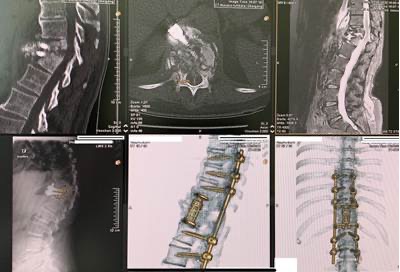
A patient underwent a thoracoscopic disc surgery at the level Th11/12 in another clinic. Shortly after the procedure, she developed severe back pain accompanied by progressive weakness in both legs and loss of bladder control.
In response to the worsening symptoms, a stabilization procedure of the affected spinal segment was performed at the same clinic. However, despite the additional surgery, the patient’s neurological condition continued to deteriorate.
She was subsequently referred to our clinic as an emergency case. Advanced imaging and laboratory investigations revealed a severe postoperative infection at the Th11/12 level involving the previously implanted instrumentation.
After careful imaging evaluation and meticulous surgical planning, we performed revision surgery. During the procedure, the infected implants were removed and the infected portions of the spine were carefully debrided using minimally invasive surgical techniques. The spine was then re-stabilized to restore structural integrity and protect neurological function.
Following surgery and appropriate medical treatment, the patient showed significant neurological recovery. She was able to walk independently again and regained a substantial degree of bladder control, with marked improvement in her overall condition.
This case demonstrates the importance of early recognition and specialized management of postoperative spinal infections, as well as the effectiveness of modern minimally invasive revision techniques in restoring spinal stability and neurological function.
With early diagnosis and appropriate treatment, many patients recover well from spinal infections.
Timely management helps prevent permanent neurological damage and long-term spinal complications.
When Should You Seek Medical Advice?
Medical evaluation is recommended if you experience:
These symptoms may indicate a spinal infection requiring urgent medical assessment.
If you are experiencing persistent back pain accompanied by signs of infection, early evaluation is essential.
Book your appointment at Fakeeh University Hospital Dubai to receive expert diagnosis and specialized spine care.